Nov 25, 2026
There’s a saying in Saskatchewan that we’re all just a few people away from knowing each other, and if you’ve ever lived here, you know how true that can be. A new acquaintance becomes a familiar face when you discover they grew up with your cousin, worked with your neighbour, or know your best friend’s parents. Around here, six degrees of separation might be closer to two.
Community is about more than who you know though. It’s about how we show up for the people around us. It’s the neighbour who clears your sidewalk after a snowfall, the community that rallies around a bottle drive, or the folks who keep an eye on the forecast when a storm is coming and checks in with those traveling. It’s a willingness to roll up our sleeves, lend a hand, and look out for one another.
That sense of connection and shared responsibility is one of Saskatchewan’s greatest strengths. And it’s something we can draw on to tackle some of our most complex challenges.
Seeing the bigger picture
Over the past 15 years, I’ve had the privilege of witnessing the power of community through my role at the Health Quality Council. As an organization dedicated to accelerating improvement, our work is rooted in partnership with health organizations, government, community organizations, and communities across Saskatchewan. I’ve seen firsthand how coming together with a shared purpose can drive meaningful change.
And with this, over time, I’ve come to appreciate that healthcare, and the broader factors that impact health and well-being, are part of a much larger, complex system within an environment that is constantly changing.
This is especially true in the context of aging well at home and in community. Health and well-being doesn’t live within one organization or health clinic. Yet, by design, the care and supports older adults rely on are fragmented. Often spread across organizations, communities, and sectors, these invisible boundaries can make it harder for older adults and their caregivers to navigate and access the right care and supports when and where they need it.
To truly strengthen aging in place, we need to look beyond individual programs and traditional, linear improvement approaches and consider how they are coordinated, connected, and situated in the broader ecosystem that surrounds them.
A different way forward
But that’s easier said than done!
One idea that really resonated with me came from trusted strategist, Bill Bannear. He challenged the notion that we should be trying to design “the solution.” Complex challenges rarely have one perfect answer waiting to be discovered and scaled. Instead, we should be creating the conditions for emergence – aka, building relationships rooted in collaboration and trust, bringing different perspectives together, and making room for multiple solutions to take shape.
And that’s a strength we have here in Saskatchewan. While gaps in care and services for older adults and their caregivers still exist, there are also a lot of incredibly innovative ideas, programs, and services taking shape across the province. Combining Bill’s approach with the Two Loops model by Margaret Wheatley and Deborah Frieze of the Berkana Institute, we wondered what might be possible if we helped bring people, ideas, and efforts closer together.
So, curious about what could emerge from those connections, we set out to put this new thinking to the test.
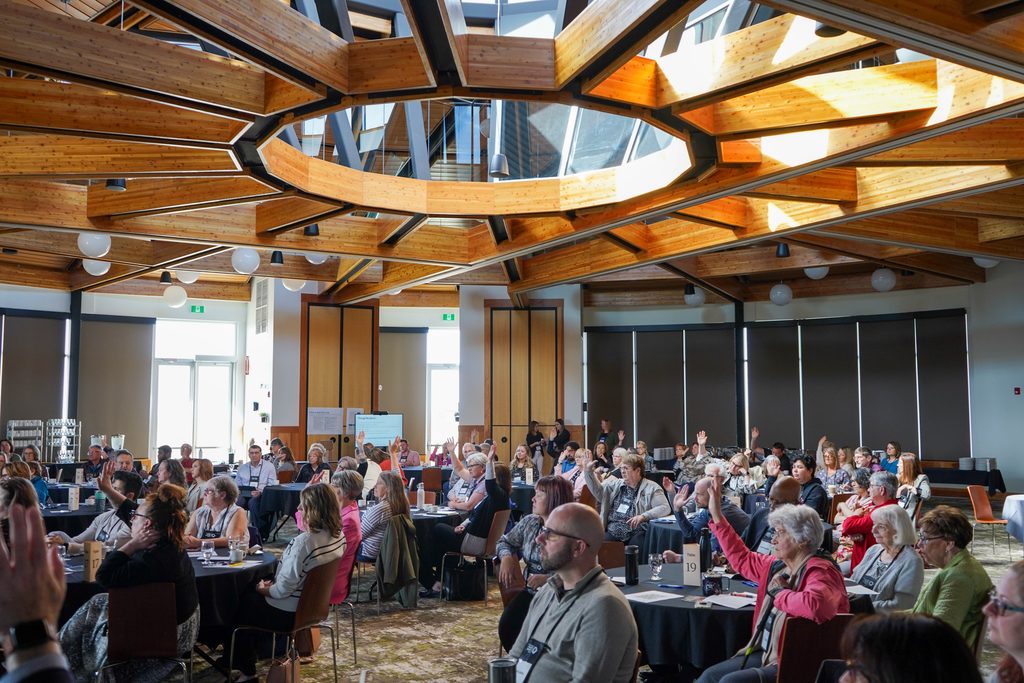
In April 2024, we brought together over 200 community partners for our first Thrive at Home Workshop: Re-Envisioning Community Supports for Older Adults, an opportunity to begin building an ecosystem of support for community-dwelling older adults in Saskatchewan. Inspired by the energy in the room, this event sparked the creation of the Thrive at Home Action Community.
From paper sketches to building connections
I remember exploring several collaboration models, sketching out possibilities for how they might work in the context of aging in place. Early in the process, during an engagement session, I asked people which approach they liked best and how we might like to work together.
Reflecting back, I was asking the wrong question.
I was too focused on the “how” we could work together and failed to lean in, and listen, to what was important to those providing care and supports to older adults. We quickly learned we needed to take a step back and establish a shared understanding of the collective aging in place landscape in Saskatchewan. Who else is working in this space? On what? With whom and how?
This was a lightbulb moment.
Meaningful collaboration starts with meaningful relationships. We first needed to create the space for people to connect, build trust, share candidly, and learn from one another. Only then could we begin to see what might be possible together.
We knew that those working to support older adults were already stretched, with limited capacity and competing priorities. The last thing they needed was another series of meetings to talk about the challenges they already understood. As we listened and learned from older adults and those supporting them, one message came through loud and clear: it’s time for action.
This led us to explore the concept of impact networks. As David Ehrlichman describes them in his book Impact Networks: Create Connection, Spark Collaboration, and Catalyze Systemic Change, these networks “bring together actors from across systems to connect, learn, and collaborate together to address complex issues.”
In April 2024, the Thrive at Home Action Community – the first impact network of its kind in Saskatchewan – was born.
The leap of faith
Taking an impact network approach proved to be both terrifying and freeing.
As an improvement lead, much of my experience had centered on getting best practice into practice. I was accustomed to building capacity, coaching others, and helping lead improvement work. Then, my role shifted. I became what some call a “Network Weaver.” Rather than planning and leading the work, my focus became creating the conditions for communities, organizations, government, and older adults to connect, learn, and take action together.
The terrifying part? We didn’t have a clearly defined roadmap or pre-determined solution. Would people show up, stay engaged, and see value in this approach? Would it…work?
But there was freedom in that uncertainty too. We could let go of the pressure to develop detailed implementation plans or have all the answers upfront. Instead, we could focus our energy on trusting the process and the power of the network itself.
Would you know it, people showed up. Within two years, we saw meaningful ideas take shape and action begin to ripple within and beyond the network.
Through this experience, I finally came to understand something Bill Bannear emphasized – that for complex system change, we need to place greater value on relationships themselves. Not just for what they help us accomplish, but as a key outcome in itself.
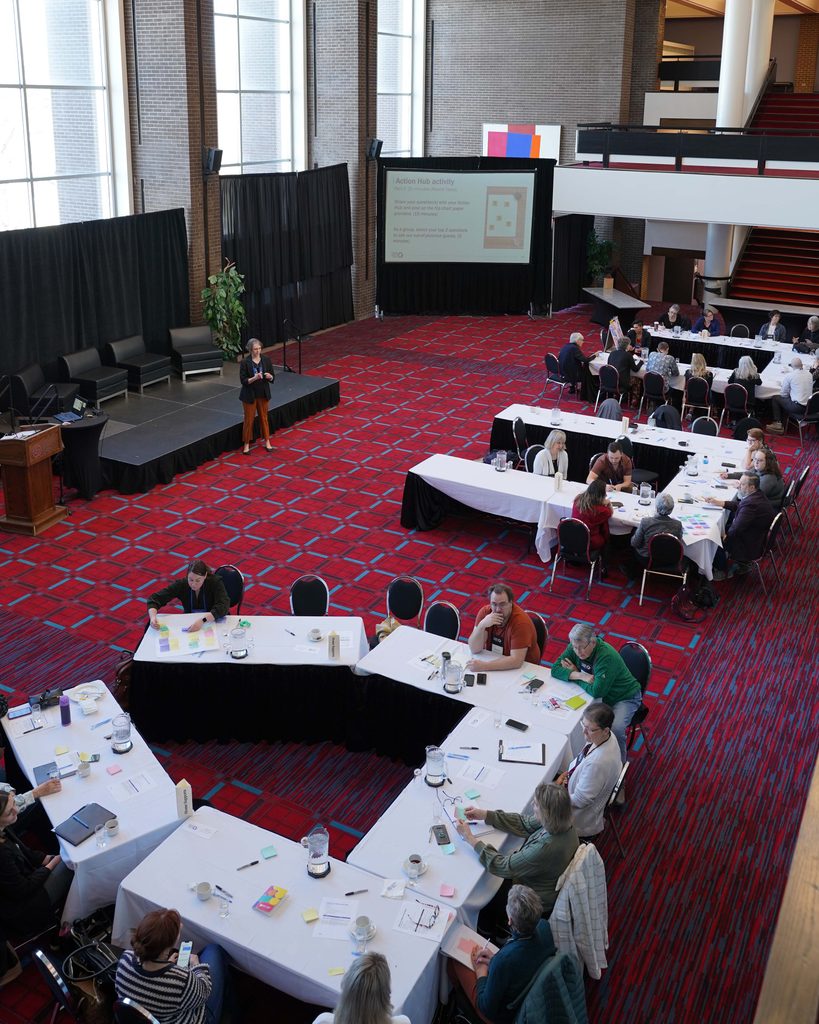
To promote system-wide collaboration, Jennifer Wright helped facilitate a Thrive at Home Action Community workshop in March 2025, focused on co-designing an integrated approach to aging well in Saskatchewan.
Key ingredients in the journey
- Built foundational relationships – We created spaces for people who don’t normally get to connect, intentionally building bridges that encouraged shared learning and collaboration across communities, organizations, and sectors.
- Cultivated trust – We welcomed diverse perspectives and made space for both agreement and disagreement, navigating tensions while staying grounded in the network’s shared purpose.
- Started with the first next step – Rather than designing and planning the network upfront, we allowed it to evolve through learning and action. Everyone brought forward ideas, and together, we shaped them into something meaningful.
- Provided multiple ways to engage – We created opportunities for people to contribute in ways that reflected their interests, strengths, and capacity, which allowed folks to participate in the ways that felt most meaningful to them.
- Watched the magic unfold – Partners within the network didn’t contribute – they led. The network was shaped by the people involved, allowing leadership to emerge organically. Those partners became, and continue to be, the strongest ambassadors for the work taking place.
Focusing on these “network ingredients” created an important shift. The Thrive at Home Action Community became less about what HQC was doing and more about what became possible when people found one another, built trust, and chose to act together.
What we learned
Over the past three years, Thrive at Home has changed how I think about tackling complex challenges.
I’ve learned that not every challenge has a best practice waiting to be put into action. Not every solution can be scaled or replicated across the province in the same way. When it comes to multifaceted issues like aging in place, meaningful progress comes from bringing together evidence and promising practices with lived experience, local knowledge, and collective action.
By breaking down silos and building connections across the many communities, organizations, and sectors that support older adults, I came to realize that our greatest strength wasn’t any one program or solution. It was the network itself.
Thrive at Home has also reminded me that while Saskatchewan may be small in population, we have a big heart. Across the province, there are people doing incredible work to support older adults and, just as importantly, people who are willing to learn from and help one another. The knowledge, passion, and commitment are already there. Sometimes, it’s about creating the connections that bring them together.
That’s something I find so fulfilling about being part of HQC. Our position gives us the unique ability to bring new ideas, approaches, and ways of working into the health system, create space to test them in a Saskatchewan context, and learn alongside the people making them happen. We get to see what’s possible when people are given the opportunity to think differently, try something new, and build something together. There’s something pretty special about watching that unfold.
When we take the time to nurture connections, we create opportunities for people to share what they’re learning, build on each other’s efforts, and work together toward a shared vision for the future.
And that’s where meaningful, impactful change can take shape.